{{ 'fb_in_app_browser_popup.desc' | translate }} {{ 'fb_in_app_browser_popup.copy_link' | translate }}
{{ 'in_app_browser_popup.desc' | translate }}
魚油是近年熱門的營養補充品,但魚油怎麼吃、一天吃多少,以及 TG、EE、rTG 有什麼差異?本文將一次解析魚油的種類、吃魚油的好處、建議攝取量、挑選重點及常見問題,幫助您找到適合自己的補充方式。
廣義而言,魚油是從魚類組織中取得的油脂;市售魚油營養補給品則通常經過萃取、純化與濃縮,以補充必需脂肪酸 Omega-3。因此,一般看到的魚油商品,都會選擇從富含 Omega-3 脂肪酸的海魚萃取,常見來源包括鯷魚、沙丁魚、竹筴魚、鯖魚、鮭魚、鮪魚等。
魚油本身含有多種脂肪酸,包括飽和脂肪酸、單元不飽和脂肪酸及多元不飽和脂肪酸,其中 Omega-3 與 Omega-6 都是人體需要的營養素。不過,現代飲食通常不難攝取足夠的 Omega-6,Omega-3 則可能不足,因此許多人會透過飲食調整或魚油營養補充品,增加 Omega-3 的攝取。
Omega-3 是一系列脂肪酸的統稱,飲食中最常見的種類包括 ALA、EPA 與 DHA:
ALA(α-次亞麻油酸):主要存在於亞麻仁籽、奇亞籽、核桃及部分植物油中,也是人體無法自行合成、必須由飲食取得的必需脂肪酸。
EPA(二十碳五烯酸):主要存在於魚類、海鮮與海洋來源油脂中。
DHA(二十二碳六烯酸):同樣主要存在於魚類、海鮮及藻類來源食品中。
人體可以將部分 ALA 轉換成 EPA,再進一步轉換成 DHA,但轉換效率有限,且會受到性別、基因、營養狀態與整體飲食組成等因素影響。因此,若希望直接增加 EPA、DHA 的攝取,通常可透過食用魚類、海鮮,或選擇魚油與藻油等營養補充品。
魚油營養補給品可能依魚種或萃取部位而有不同的名稱,例如一般魚油、魚眼窩油與魚肝油。三者都可能含有 EPA 與 DHA,但原料來源、萃取部位及營養組成有所不同,實際成分仍會因魚種、製程及產品配方而有所差異。整體而言,主要差異如下:
一般魚油:通常由魚脂肪組織萃取,主要營養成分為 EPA 與 DHA。
魚眼窩油:由魚眼及眼窩周邊含油組織製成。由於眼窩組織 DHA 含量較高,部分產品以較高 DHA 比例為特色。
魚肝油:由魚類肝臟萃取,除了 EPA、DHA,也可能含有維生素 A 與維生素 D。
若補充目的為增加 EPA、DHA 的攝取,建議選購時查看營養標示,除了確認魚油來源和魚油總量以外,更要注意每份所含的 EPA、DHA 含量。
魚肝油則通常作為補充維生素 A 與 D 的營養補給品,但選擇時也建議留意維生素 A、D 的含量,並將飲食及其他營養補充品中的攝取量一併納入考量,避免長期重複補充而導致攝取過量。
挑選魚油營養補充品時,常會看到 TG、EE、rTG 等標示。這些是指 Omega-3 脂肪酸 EPA、DHA 在魚油中的存在形式,也可以簡單理解為 EPA、DHA 的「包裝方式」。不同製程會讓 EPA、DHA 以不同形式存在。
天然魚油中的 EPA、DHA 主要以 TG 的形式存在。為了提高 EPA、DHA 的濃度,魚油在濃縮製程中常會先轉換為 EE 型態;後新發展出的技術,可再將 EE 轉換成 rTG。
類型 | 全名 | 特色 |
|---|---|---|
TG | Triglyceride(三酸甘油酯) | 魚體中脂肪的天然型態 |
EE | Ethyl Ester(乙酯型) | 傳統蒸餾濃縮後的魚油型態,由魚體脂肪中萃取出的 EPA、DHA 類型 |
rTG | Re-esterified Triglyceride(再酯化三酸甘油酯) | 將濃縮後的 EE 魚油再經製程轉換回 TG 的型態 |
為什麼了解 TG、EE、rTG 重要呢?研究認為不同型態可能影響人體對魚油的吸收利用率。
目前部分研究認為,rTG 的生物利用率可能高於 EE,較容易被人體吸收利用。不過,目前相關研究數量仍有限,不同研究所使用的產品配方、製程、EPA、DHA 含量及受試者條件皆有所差異,因此仍需要更多研究進一步證實。
另外,也有研究指出,在單次補充魚油的情況下,EE 的生物利用率確實較低;但若長期規律補充魚油,不同型態產品所提升的血中 EPA、DHA 濃度,可能沒有顯著差異。因此,除了魚油型態之外,EPA、DHA 的實際含量、產品品質、氧化程度及是否規律補充,同樣都是影響補充效果的重要因素。
Omega-3 是人體重要的營養素,參與多項身體代謝作用,有助於調節生理機能。
部分研究(註1)發現,補充含 EPA、DHA 的 Omega-3,可能有助於維持良好的精神狀態與專注力。
部分統合分析及 umbrella review 指出,補充 Omega-3 有助於放鬆心情,維持良好的情緒狀態。
懷孕及哺乳期間,DHA 等營養素的需求增加,適當攝取有助於滿足孕期與哺乳期的營養需求。
有研究指出,運動員較容易出現 Omega-3 攝取不足的情況,而補充 Omega-3 可協助運動後恢復。
每個人適合攝取的 Omega-3 脂肪酸量,會隨每日熱量需求而有所不同。
根據衛生福利部《國人膳食營養素參考攝取量(Dietary Reference Intakes, DRIs)》第八版建議,ALA、EPA、DHA 三種 Omega-3 脂肪酸的每日總攝取量,應占每日總熱量的 0.6%~1.2%。
營養師補充:若甲君每日所需熱量 1,500 大卡,Omega-3 每日建議補充量的計算方式如下:
第一步:算出 Omega-3 脂肪酸應提供的熱量:
「每日所需熱量」x 0.6%~「每日所需熱量」x 1.2%
1,500 × 0.6%~1,500 × 1.2% = 9~18 大卡
第二步:將 Omega-3 脂肪酸應提供的熱量,換算成脂肪克數:
每公克脂肪可提供 9 大卡熱量
9 ÷ 9~18 ÷ 9 = 每日約 1~2 公克 Omega-3 脂肪酸
雖然魚油中的 Omega-3 脂肪酸對人體有許多益處,但並非補充越多越好,仍應依照建議攝取量食用。攝取過量時,部分人可能出現腸胃不適或其他輕微副作用,常見症狀包括(註2):
胃灼熱
噁心
腸胃不適
腹瀉
頭痛
體味較明顯,或汗液帶有異味
另外,魚油也可能引起一些較常見但通常不嚴重的不良反應,例如:
魚腥味
打嗝(魚腥味打嗝)
Omega-3 營養素也可透過一般飲食補充,但以下族群可能較容易出現 EPA、DHA 攝取不足的問題。可以考慮額外的魚油營養補給品,但仍應依個人健康狀況與醫療專業人員建議選擇適合的產品與劑量。
EPA、DHA 主要存在於海洋魚類中,因此平時很少吃魚、幾乎不吃海鮮,或飲食中缺乏富含 Omega-3 魚類的人,較可能需要額外補充。
DHA 在胎兒及嬰兒發展中,扮演重要角色。若孕婦或哺乳者平時魚類攝取不足,可在醫師或營養師建議下,選擇適當的 DHA 或魚油產品補充。
並非所有人都適合額外補充魚油。若符合以下情況,建議補充前先與醫師或藥師討論,以確認是否適合食用及補充劑量。
魚油可能與部分藥物產生交互作用,因此若正在服用相關藥物,建議先諮詢醫師或藥師,再評估是否需要額外補充魚油。
常見可能需要留意的藥物包括:
抗凝血藥、抗血小板藥:如 Warfarin、Clopidogrel、Aspirin 等。
非類固醇消炎止痛藥(NSAIDs):如 Ibuprofen、Naproxen 等。
若近期安排手術,應主動告知醫療團隊是否有補充魚油。是否需要於術前暫停補充,應由醫師依魚油劑量、手術種類、出血風險及合併用藥等因素綜合評估。
對嚴重魚類過敏者,建議在補充魚油前,先諮詢過敏專科醫師或藥師,並確認產品原料及過敏原標示;必要時,可由專業人員評估是否改用藻油等非魚類來源的 Omega-3 補充品。
建議隨餐食用,尤其是搭配含有適量油脂的正餐。人體消化脂肪時,需要膽汁及脂肪酶參與,與正餐一起食用有助於啟動脂肪消化與吸收機制,提升魚油中 EPA、DHA 的吸收利用率。
此外,魚油隨餐補充也有助於降低魚腥味打嗝、胃部不適等腸胃道副作用。
魚油並非一次大量補充就能達到效果,依照建議攝取量長期且規律補充,較為適合。
除了魚油營養補充品外,也可以透過天然食物攝取 Omega-3,例如鮪魚、沙丁魚、鯷魚、鯖魚等富含油脂的魚類;植物性來源則包括亞麻仁籽、奇亞籽、核桃、亞麻仁籽油、紫蘇油等。
目前沒有科學證據顯示晚上補充魚油會影響睡眠或導致失眠,魚油補充時間較無限制,但建議與正餐一同補充。
若希望直接補充 DHA 或 EPA,可選擇藻油(Algal oil)產品,以海洋微藻中作為 DHA、EPA 營養素的來源。
此外,素食者也可透過植物性食物補充 Omega-3,例如亞麻仁籽、奇亞籽、核桃及其相關製品,可提供 ALA(α-次亞麻油酸)。不過,由於人體將 ALA 轉換為 EPA、DHA 的效率有限,因此若希望直接補充 EPA、DHA,仍可考慮藻油產品。
目前沒有研究顯示魚油與維生素 B 群會產生交互作用,因此一般情況下可以一起補充。
【延伸閱讀】你真的吃對魚油了嗎?魚油功效、吃法與選購重點一次看
確認魚油來源:是魚油、魚眼窩油,還是魚肝油。
確認 EPA、DHA 含量:挑選魚油時,應確認每份 EPA、DHA 的實際含量,較可以掌握實際補充的營養素。
觀察魚油的顏色與氣味:品質良好的魚油通常呈現淡淡微黃色、近透明,氣味自然,若顏色為明黃或有霧霧的感覺,甚至有明顯腥臭味或油耗味,可能代表魚油已氧化。
優先選擇 PTP 片裝包裝:PTP 獨立片裝可減少魚油與空氣、光線接觸,有助於降低氧化、維持產品品質。
優先選擇小型魚種來源:鯷魚、沙丁魚等小型魚位於食物鏈較低層,重金屬及環境污染物累積的風險通常較低。
看完魚油的功效、吃法與挑選原則後,你會發現,挑魚油不能只看「Omega-3 濃度有多高」,EPA、DHA 實際含量、魚油型態、原料來源、新鮮度與成品檢驗,都是值得一起確認的關鍵。
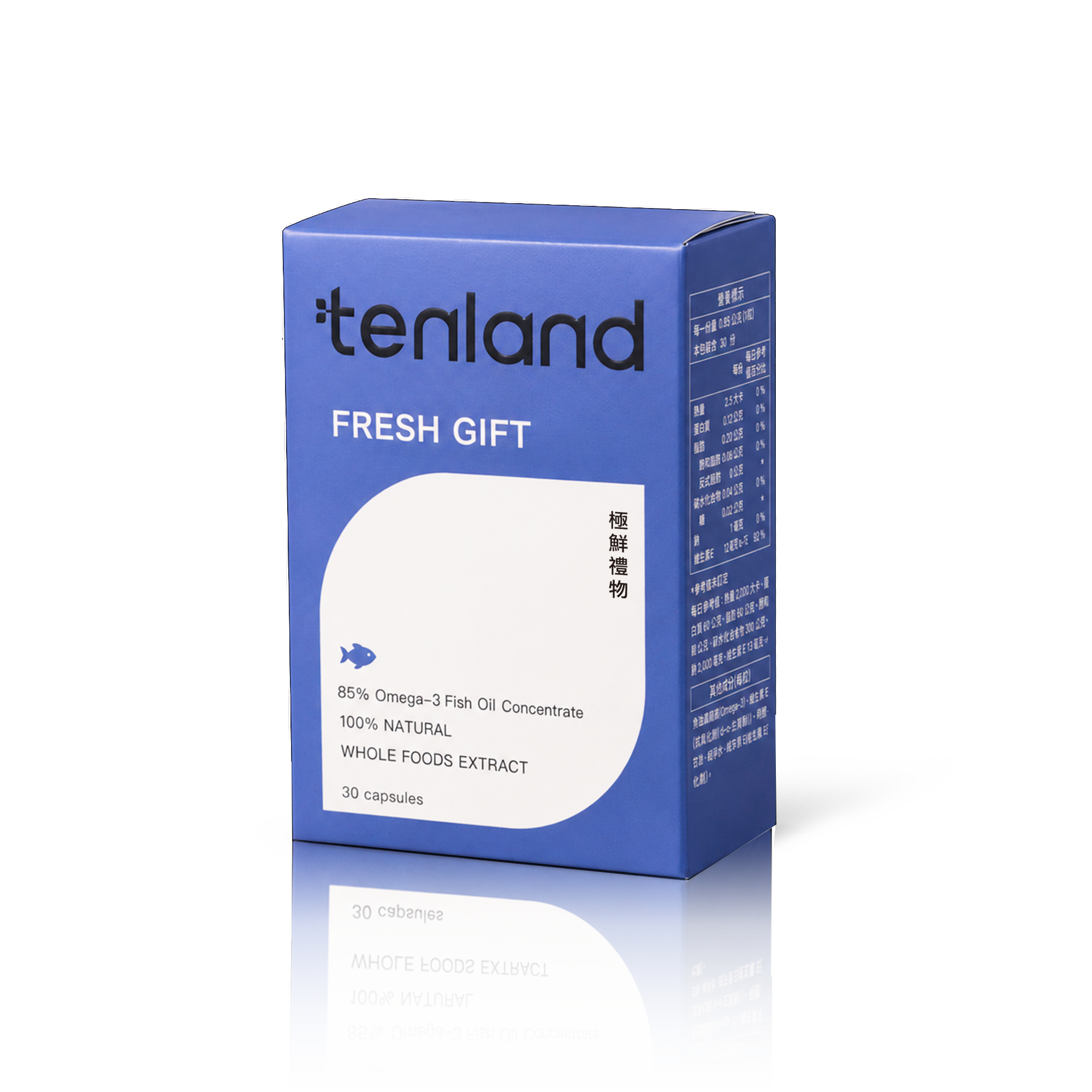
tenland®【極鮮禮物】選用挪威百年魚油大廠 Epax® 高濃度 rTG 魚油,原料來自沙丁魚、鯷魚、鯖魚等小型深海魚,來源可追溯;每日 2 顆可補充 Omega-3 860 mg,其中 EPA 480 mg、DHA 320 mg。EPA:DHA 採 3:2 比例,不是刻意追求所謂的「完美比例」,而是參考小型海洋魚類原有的脂肪酸組成,讓日常補充更貼近原型食物的營養樣貌。
除了營養規格,【極鮮禮物】也將「新鮮度」納入魚油挑選標準,從酸價、過氧化價、茴香胺價到 TOTOX 等氧化指標進行品質管理,並採用特殊除臭技術與小尺寸軟膠囊,減少魚腥味帶來的食用負擔。每顆再以 PVDC 獨立抗氧防潮包裝保存,降低反覆開封接觸空氣與濕氣的影響。
在安全把關上,【極鮮禮物】成品堅持逐批第三方檢驗,包含重金屬、塑化劑、環境污染物及魚油新鮮度等項目,讓魚油的品質不只是看原料規格,而是連真正每天吃進去的成品都能被檢視。
如果平時外食比例高、較少攝取魚類,或想更有效率地補充 Omega-3,可以進一步了解【極鮮禮物】Omega-3 高濃度魚油。

參考資料:
https://pubmed.ncbi.nlm.nih.gov/12442909/ omega-3 與 omega-6 的比例
https://www.researchgate.net/publication/366919522_FISH_LIVER_OIL_OMEGA-3_FATTY_ACID_AND_HUMAN_HEALTH fish liver oil
https://resources.healthgrades.com/right-care/cholesterol/cod-liver-oil-vs-fish-oil liver oil
https://www.medicalnewstoday.com/articles/270071#benefits liver oil
https://www.sciencedirect.com/topics/agricultural-and-biological-sciences/fish-liver-oils liver oil
Fish liver oils are especially rich in vitamins A and D and are therefore high-grade carriers of vitamins.
https://www.sciencedirect.com/topics/agricultural-and-biological-sciences/tuna-oil
https://hdl.handle.net/11296/m5k5kv 眼窩魚油&DHA
Polyunsaturated fatty acids of tuna orbital adipose tissue constitute 40.06 % of the total fatty acids, and DHA is the most abundant one which constitutes 30.57 % of the total fatty acids.
https://epubs.icar.org.in/index.php/FT/article/view/58290 眼窩魚油&DHA
https://www.tandfonline.com/doi/abs/10.1271/bbb.60.962 眼窩魚油&DHA
https://ods.od.nih.gov/factsheets/Omega3FattyAcids-HealthProfessional/
https://nutritionsource.hsph.harvard.edu/fish/
https://pubmed.ncbi.nlm.nih.gov/8491162/ 魚油與長期補充
https://pubmed.ncbi.nlm.nih.gov/17876198/ 魚油與長期補充
https://pubmed.ncbi.nlm.nih.gov/9374124/ 魚油與長期補充
https://pmc.ncbi.nlm.nih.gov/articles/PMC7717546 魚油與長期補充
「魚油中的 EPA、DHA 需要持續補充一段時間,逐漸整合至血液與細胞膜,因此相關健康效益通常需經過數週至數月才較容易觀察到。」
https://www.sciencedirect.com/science/article/pii/S0163782724000511 TAG/EE/rTAG
Marine fish are the main source for EPA- and DHA. The amount of LC n-3 PUFAs varies considerably between fish species. Oily fish generally contains higher LC n-3 PUFA levels compared to lean fish. The habitat of the fish also plays an important role. LC n-3 PUFAs are primarily found in cold-water fish like cod, herring, mackerel, salmon, anchovy, menhaden, and sardine. An exception is tuna (e.g., Albacore), which as a warm-water fish also contains comparatively high LC n-3 PUFA contents.
FOs derived from these fishes are highly susceptible to oxidation and must be refined to remove contaminants, and undesirable substances (such as non-esterified fatty acids, oxidation products, and environmental toxins) to produce edible oils for the use as drug, dietary supplement or additive to foods. This process typically includes steps such as degumming, neutralization, bleaching, and deodorization. Refined unconcentrated FO make up the majority of all n-3 oils for dietary supplements [8]. These oils contain approximately 18 % EPA and 12 % DHA relative to the total amount of FA. EPA and DHA are mainly bound to TAGs and, to a lesser extent, as NEFA. With around 30 % EPA and DHA content, each TAG molecule typically contains one long-chain (LC) n-3 PUFA. In natural “unmodified” TAGs (uTAGs), about 50 % of EPA or DHA are bound at the 2-position (sn-2), while two other short-chain or mid-chain FA are bound in the 1- and 3-positions (sn-1/3) [9,10]. A smaller proportion of EPA and DHA in uTAG is esterified in positions sn-1 and sn-3.
https://pubmed.ncbi.nlm.nih.gov/40025684/ 魚油型態與生物利用率 2025
Thus, this review aims to describe the influence of fish oil processing on the omega-3 bioavailability in humans.
Currently, omega-3 is more bioavailable when ingested as free fatty acid, followed by triglyceride, and lastly as ethyl ester.
Due to their high susceptibility to oxidation and preliminary findings, administering omega-3 in the form of triglyceride may be the most suitable to maximize bioavailability.
https://pmc.ncbi.nlm.nih.gov/articles/PMC9882700/ 魚油保健食品製程 2023
Fish oil is routinely concentrated into unmodified triglycerides, or trans-esterified into an ethyl ester form. Re-esterification of the ethyl ester form yields re-esterified triglycerides (rTG), which are reportedly more bioavailable than ethyl ester forms. However, the fidelity of the re-esterification process may yield variable triglyceride forms, with only 55–60% being rTG.
濃縮魚油的製程中,常見的一種方式是先轉成 EE。
https://pubmed.ncbi.nlm.nih.gov/25218856/ 魚油型態的生物利用率(反對論點)2014
The apparent bioavailability (as defined by the authors of these studies) seems to be lowest for the EE form and highest for the FFA form, whilst no conclusion can be made for TAG versus PL from human data.
The major limitations with the studies to date include: (between studies) loose definition of the term "bioavailability", lack of standardisation of analytical methodology, and differences in which blood compartment was analysed; (within a study) failure to provide equal amounts the n-3 LC-PUFA of the different forms being compared, failure to provide the dose of n-3 LC-PUFA on a body weight basis, failure to measure fatty acid excretion, failure to control the total fat intake, and failure to adequately power the studies from a statistical point of view.
https://www.sciencedirect.com/science/article/pii/S0163782724000511 魚油與生物利用率 2025
Acute bioavailability differences often do not persist in chronic supplementation.
長期補充的話,(不同型態的魚油)生物利用率不一定有明顯差別
Bioavailability for isolated chemically forms followed the order: NEFA > PL > rTAG > unmodified TAG > ethyl esters (EE).
Significant differences observed in acute bioavailability studies (e.g., faster absorption) often did not translate into long-term impacts in chronic supplementation studies.
單次有明顯差異
https://pmc.ncbi.nlm.nih.gov/articles/PMC9882700/ 2023
tenland 舊文提到「不同品牌間實際rTG比例不同,越高越好」的支持證據
These data suggest that the percentage of rTG in rTG fish oil preparations may evolve as a new chemoprofile/quality control marker that can influence its lipidomic pharmacodynamics. Additional investigations to assess the physiologic/vascular and metabolic/inflammasome responses to concentrated fish oil preparations differing in the percentage of rTG are warranted.
1 作者本身也是比較保守的態度,而不是直接說「越高越好」。
2 第一作者是來自 Department of Research, Nordic Naturals 也就是他在研究自己的產品(...),雖然有聲明沒有利益衝突,但還是可以考慮一下這點。產品:Ultimate Omega®; Nordic Naturals
3 rTG的含量不是唯一差別,EPA 跟 DHA 的劑量也有差異(雖然很小)
● One group received a >95% rTG (Ultimate Omega®), as 1,000 mg capsules containing 325 mg eicosapentaenoic acid (EPA) and 225 mg docosahexaenoic acid (DHA) = 325 mg EPA + 225 mg DHA
● the other received a <70% rTG (MEG-3) as 1,000 mg capsules containing 300 mg EPA and 200 mg DHA = 300 mg EPA + 200 mg DHA
https://ods.od.nih.gov/factsheets/Omega3FattyAcids-HealthProfessional/ 魚油與身體不適
Commonly reported side effects of omega-3 supplements are usually mild. These include unpleasant taste, bad breath, heartburn, nausea, gastrointestinal discomfort, diarrhea, headache, and odoriferous sweat [161,190].
https://www.ncbi.nlm.nih.gov/books/NBK564314
The FDA-approved fatty acid prescriptions (icosapent ethyl, omega-3-acid ethyl esters, omega-3-carboxylic acids, and omega-3-acid ethyl esters A) are generally safe with benign effects such as fishy taste, eructation, dyspepsia, diarrhea, gas, nausea, and arthralgia.
https://ods.od.nih.gov/factsheets/Omega3FattyAcids-HealthProfessional/
Commonly reported side effects of omega-3 supplements are usually mild. These include unpleasant taste, bad breath, heartburn, nausea, gastrointestinal discomfort, diarrhea, headache, and odoriferous sweat [161,190].
https://ods.od.nih.gov/factsheets/Omega3FattyAcids%20-Consumer/
The U.S. Food and Drug Administration recommends consuming no more than 5 g/day of EPA and DHA combined from dietary supplements. Any side effects from taking omega-3 supplements are usually mild. They include an unpleasant taste in the mouth, bad breath, heartburn, nausea, stomach discomfort, diarrhea, headache, and smelly sweat.
https://www.ncbi.nlm.nih.gov/books/NBK564314/
The FDA-approved fatty acid prescriptions (icosapent ethyl, omega-3-acid ethyl esters, omega-3-carboxylic acids, and omega-3-acid ethyl esters A) are generally safe with benign effects such as fishy taste, eructation, dyspepsia, diarrhea, gas, nausea, and arthralgia.[4][64][65] Researchers noted adverse reactions in clinical trials for each FDA-approved omega-3 fatty acid product.[4][3][6]
【本文由tenland®編輯團隊撰寫】